
Worcester Scheduled and Actual Release
A projected or scheduled release date is a current calculation. It is not the release event. For a state sentence, DPSCS begins with the controlling judgment and aggregate term, accounts for pretrial custody credit, and applies the law governing parole eligibility and diminution credits. “Aggregate” means the combined term after concurrent and consecutive sentences are arranged. For a local term at Worcester County Jail, the Jail’s own authorized computation is the source. State-prison credit rates should not be copied onto a local jail sentence.
The actual release date is when the custodian relinquishes physical custody. That departure might be to the community, mandatory supervision, parole, treatment, another county, DPSCS, ICE, or federal custody. A transfer date can match the day someone leaves the Snow Hill jail without being a community release. The release record should identify the event type and receiving agency when that field is releasable.
Scheduled versus actual: A computed date can change. Only the custodian’s release record proves when and how physical custody ended.
A pretrial detainee has no sentence-expiration date. The useful records are the bond decision, release conditions, commitment, warrant status, and later court action. A predicted day based on a hearing calendar is not an official Worcester County release date.
Worcester DPSCS Date Search Limits
Maryland’s public Incarcerated Individual Locator searches first and last name and reports the facility location of covered people currently in state custody. It does not expose a verified projected, tentative, maximum-expiration, or past-release field. DPSCS also says people no longer in custody for any reason, including release or escape, are not listed. A no-result page therefore cannot prove release.
DPSCS does use projected dates internally. Its reentry service says planning meetings occur within 180 days of projected release, and Victim Services describes notice of expected sentence expiration. Those facts show that an agency calculation exists. They do not turn the public locator into a release-date search.
| Public locator item | What Worcester County users can conclude |
|---|---|
| First and last name inputs | Use them to search covered current state custody, then compare known identifiers. |
| Current facility result | The named institution is a lead to the current records custodian. |
| No result | It may mean release, escape, exclusion, spelling mismatch, processing delay, sealing, or another system. |
| Projected date | No verified public field exists in this Maryland locator. |
| Released date | Past released people are excluded, so request an official record instead. |
The official interface makes that limitation visible. Open the DPSCS locator and read its coverage notice before relying on a name search.
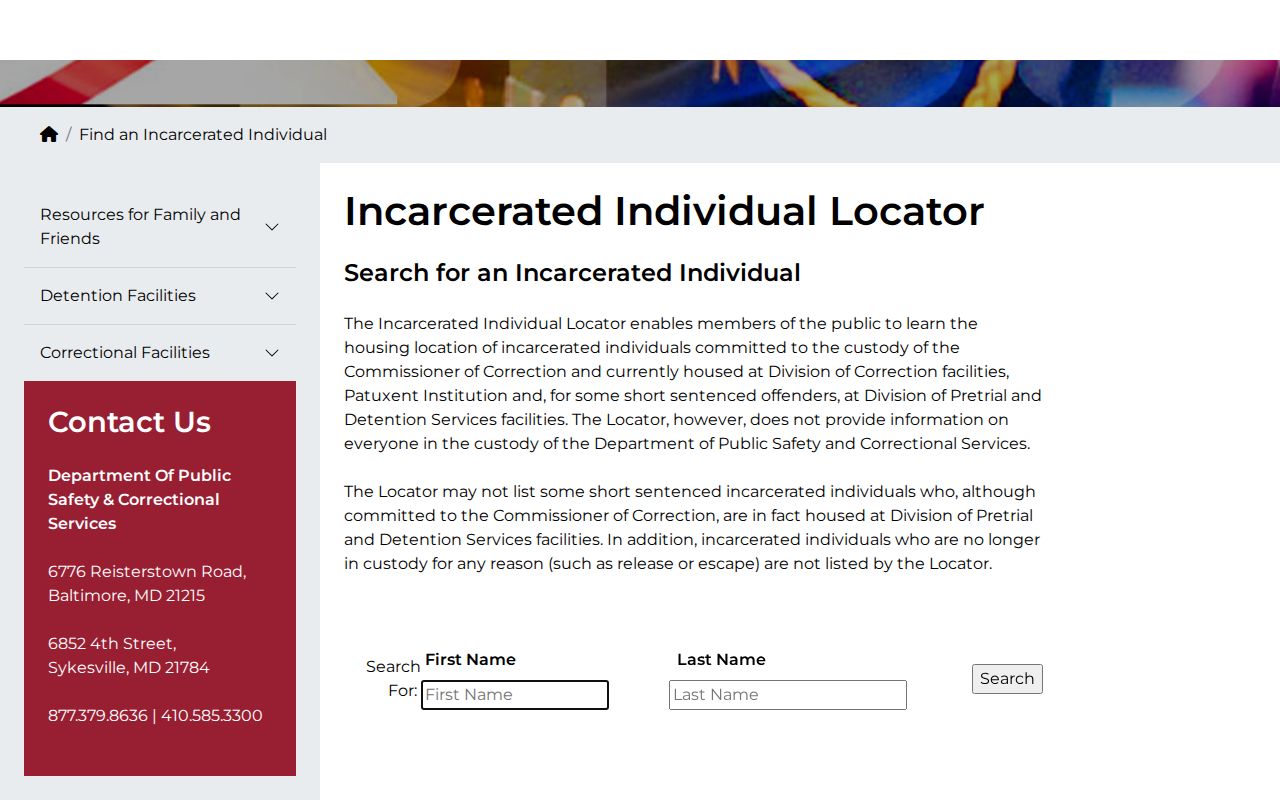
The captured notice supports the required next step: move from the public locator to the court, custodian, VINE, or records office when a date is needed.
Note: Maryland’s public state locator excludes released people, so save the institution name while a current custody result remains visible.
Find a Worcester Inmate Release Date
The correct search path changes with custody. Start by identifying whether the person is held pretrial in Worcester County, serving a local sentence in Snow Hill, serving a Maryland DOC sentence elsewhere, or under a federal or immigration authority. Do not use the sentencing county as a guess for the prison location. Worcester County has no state DOC prison identified within the county, although people sentenced there can be housed anywhere DPSCS assigns them.
- Read the Worcester County case in Maryland Judiciary Case Search. Note the sentence, credit for time served, bond action, and later modifications.
- For current Worcester County Jail custody, call 410-632-1300. Ask whether the person is pretrial or sentenced and whether an official release calculation can be disclosed.
- For current state custody, search DPSCS by name to identify the institution. Ask case management for the current calculation if you are the person or an authorized party.
- Eligible registered victims can use DOC Victim Services for expected sentence-expiration and release information. The applicable disclosure rules still control.
- For a releasable public record, use the DPSCS PIA process or Worcester County’s focused request route, depending on the custodian.
- Use VINE as an alert and status relay, then confirm the event with the jail, institution, or court record.
The county jail and state DOC calculate under different authority. A former DPSCS detainee seeking their own base file should contact the releasing institution or Case Management Office for Operations at 410-585-3300. A member of the public should ask only for releasable sentence-calculation and release fields. Privacy, safety, medical, victim, and investigatory limits may apply.
The complete county release-record workflow appears in the Worcester County released inmate search. It can help determine whether the date represents release, transfer, or a court-authorized change.
Worcester State Sentence Credit Channels
Maryland Correctional Services Article, Title 3, Subtitle 7 governs diminution credits in state correctional facilities. These credits can reduce confinement toward mandatory supervision. They do not erase the sentence. Eligibility depends on the offense, offense date, sentence type, conduct, and the version of law that controls. Actual work or program participation matters, and disciplinary credits can be revoked or, when allowed, restored.
Section 3-704 generally provides advance good-conduct deductions of ten days per calendar month, but five days applies when an aggregate term includes a covered crime of violence or specified drug offense. Partial months are prorated, and the law identifies times when credit does not accrue. This is one channel, not the whole formula.
Other channels are separate. Section 3-705 provides five days per month for satisfactory assigned work. Section 3-706 provides five days for satisfactory progress in or completion of covered education, training, cognitive, substance-use, life-skills, or antiviolence programs. Section 3-707 authorizes special-project credit up to twenty days per month, with a lower ceiling for listed sentence groups.
Combined totals are limited by Section 3-708, generally twenty days for the restricted group and thirty for others, subject to its qualifications. Section 3-702 also excludes specified categories. These are maximum statutory channels, not a promise that every incarcerated person earns each one.
Note: Ask Worcester County Jail for its local calculation policy rather than applying these state-prison credit figures to a county term.
Worcester Parole Eligibility Is Separate
Parole eligibility is not a sentence-credit total and does not set an automatic release day. Correctional Services § 7-301 supplies Maryland thresholds. Its general rule is first eligibility after one-fourth of the aggregate sentence. For a covered crime of violence committed on or after October 1, 1994, the threshold is generally the greater of one-half of the aggregate violent-crime sentences or one-fourth of the total aggregate sentence. Other rules apply to mixed terms, life sentences, specified repeat drug felonies, and life without parole.
Maryland has no universal “serve 85 percent” calculator for all sentences. Some offenses sharply limit credit or parole and can result in a high share served, but the correct Worcester County calculation depends on the precise crime, offense date, judgment, consecutive and concurrent terms, mandatory minimums, credits, and court changes. Federal truth-in-sentencing shorthand should not replace the Maryland statute.
Even an approval may not cause immediate release. The Maryland Parole Commission can require a certified home plan, program, or other pre-release condition. Its FAQ states that parole does not occur on the hearing day. The parole record, projected date, and release timestamp remain distinct.
What Changes Worcester Release Dates
An estimate starts with the court’s aggregate sentence and credit for pretrial custody. It then changes as the custodian applies the right law and receives new information. Administrative correction can move a date without a new conviction, while a new sentence or detainer can change the custody path. The current commitment and custodian calculation control.
| Factor | Possible effect | Record to check |
|---|---|---|
| Concurrent or consecutive terms | Changes the aggregate sentence structure | Sentencing order and commitment |
| Pretrial custody credit | Reduces remaining time when lawfully awarded | Judgment and sentence calculation |
| Work, education, or special-project credit | Can advance mandatory-supervision eligibility | DPSCS case-management calculation |
| Disciplinary loss or restoration | Can move the estimate later or earlier | Institutional credit record |
| Detainer or new sentence | May lead to transfer or continued custody | Custodian record and court docket |
| Appeal or sentence modification | Can alter the controlling term | Filed court order |
| Parole conditions | Can delay physical release after approval | Commission and institution notice |
No Worcester County weekend or holiday adjustment rule was found. Do not assume a Sunday date guarantees a Friday departure. Call the Jail or state institution for the actual practice and current release instruction.
Identity and timing errors can also create a false date. Match the case number, booking episode, and DOC or local inmate number where available, but keep private identifiers out of public notes. Similar names may belong to different people. A docket update can lag the signed order, VINE can lag the physical event, and the state locator can lag a transfer. Record when each source was checked. If two dates conflict, ask the custodian which calculation is current and what order or credit entry caused the change.
A hold deserves special care. A Worcester County sentence may end while another county, state, federal, or immigration authority takes custody. The first custodian’s record may correctly say “released” even though the destination field shows a transfer. Ask for the release type and receiving agency, not the date alone. That extra field separates the end of one commitment from freedom from all custody.
Confirm Worcester Release Date Alerts
Maryland VINE can send a custody-change alert for a selected record, but it is a relay from participating systems. The alert is not the court order or custodian’s release log. Register while the record can still be selected, save the confirmation, and read the exact agency, status, and update time. “Transferred,” “released,” and “out of custody” should not be treated as interchangeable words.
The VINELink Release Check explains the Maryland phone, web, and confirmation channels. When a notice arrives, call Worcester County Jail or the state institution to confirm the physical event and whether another authority took custody. Court entries may explain the legal basis but may post before or after the person leaves the building.
The strongest result is a matched set: current custodian calculation, controlling court order, and final release or transfer record. Save the date on which each source was checked. That makes later changes clear and avoids turning an old projection into a claim about present custody.
When the date is needed for planning, confirm again near the expected event. A new court order, lost credit, restored credit, receiving-agency hold, or unmet parole condition can intervene after an earlier estimate was issued. The releasing office is the only source that can state its current operational plan, and even that plan remains subject to lawful change until custody is actually relinquished.
Public Record Search
Sponsored Results